Airdrie, Rocky View County and Calgary would need to work together to make this pitch a reality
Helen Pike · CBC News · Posted: Apr 28, 2021 7:50 AM MT | Last Updated: April 28
Matthew Hicks bikes to Airdrie at least once a week to meet with clients for his photography business. (Helen Pike/CBC)
Airdrie is seriously considering a bike and pedestrian pathway that would connect the city to Calgary.
Last week, the Airdrie city council reviewed a pitch complete with costs, stakeholders to engage, and a planned-out route to pave the path — and the idea, funnily enough, was presented by a Calgary-based photographer.
About a year ago, Matthew Hicks invested in an electronic cargo bike to cut his emissions for client meetings and shoots in Calgary. But he quickly realized that between pedaling and the extra electric-assisted power, he could push his bike range to Airdrie.
Those who get around town by e-bike now have a new bylaw to refer to in determining which routes they can travel by.
A cyclist rides along Fourth Avenue in Whitehorse on October 15, 2019. The city has adopted its first e-bike bylaw. (Crystal Schick/Yukon News file)
At Whitehorse city council’s April 26 meeting, members approved third reading of the e-bike bylaw, along with changes to other bylaws to align with the e-bike bylaw.
The new regulations were passed despite more than a dozen presentations by phone and written submissions from residents opposed to parts of the bylaw. Many took issue with the classification system for e-bikes that determines which trails they may travel on.
Peel Region’s top doctor says he wouldn’t recommend reopening outdoor recreational activities right now in order to avoid mixed messaging, as the province is under a stay-at-home order amid a third wave of the COVID-19 pandemic.
Medical Officer of Health Dr. Lawrence Loh says he would not call on the provincial government to reverse its decision about closing golf courses, basketball courts and other outdoor amenities as the Region of Peel continues to see heightened coronavirus cases and hospitalizations.
“At this time, however, I think calling for reopening is a bit challenging in my position because as I've said we are still not yet out of this very severe third wave and I think to the degree that we're trying to really get people to understand essential meetings, essential purposes only and always with precautions,” Loh said during Brampton’s weekly COVID-19 press conference Wednesday morning.
It’s about to be May. It’s getting warmer across Canada.
This usually means several things: Patio season. Outdoor sports. Backyard gatherings with friends.
And yet, depending on where you reside in Canada, some or all of these things may be against the law.
For the second summer in a row, Canadians stand to be denied, well, a summer.
While many Canadians embrace the winter there are just as many others who do not and look forward to the summer as a welcomed — albeit much too short — reprieve from the cold weather.
How should Canadians deal with this inherent contradiction that many are faced with? Yes, we want summer activities. No, many such activities are not allowed — or at least not allowed to the degree we may wish.
he government of Alberta is establishing a Kananaskis Conservation Pass that will see vehicles charged a per day, or annual fee to access the region's provincial parks and recreation areas, including those located in the Bow Valley corridor.a day ago By: Tanya Fouber
Several dozen cars park along the Lac des Arcs highway exit and along the road to the Heart Creek trail head parking lot on Saturday (April 17). The parking lot was full. EVAN BUHLER RMO PHOTO
KANANASKIS COUNTRY— The government of Alberta is establishing a Kananaskis Conservation Pass that will see vehicles charged a per day or annual fee to access the region's provincial parks and recreation areas in the Bow Valley corridor.
Starting June 1, 2021, visiting K-country will cost recreational users $15 a day or $90 a year per vehicle. The regions a pass would be required includes popular hiking areas along Highway 1A, the Trans-Canada Highway and those accessed through trailheads in Canmore and around, such as Grassi Lakes.
Environment and Parks Minister Jason Nixon said Tuesday (April 27) 100 per cent of the revenues from the initiative will go directly into managing of the area and conservation initiatives to protect it into the future.


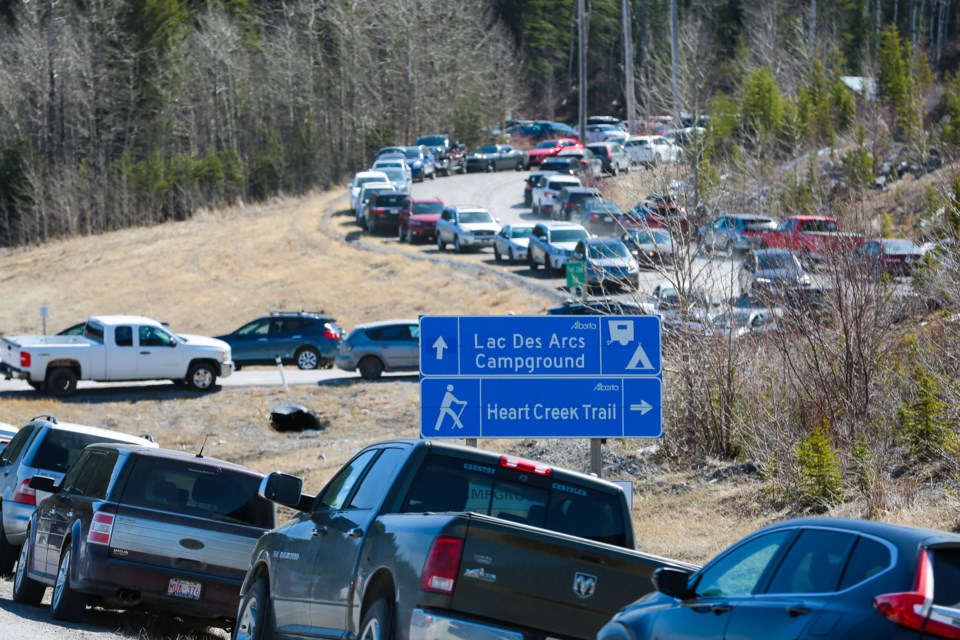 Several dozen cars park along the Lac des Arcs highway exit and along the road to the Heart Creek trail head parking lot on Saturday (April 17). The parking lot was full. EVAN BUHLER RMO PHOTO